Looking after the quarter
Planters
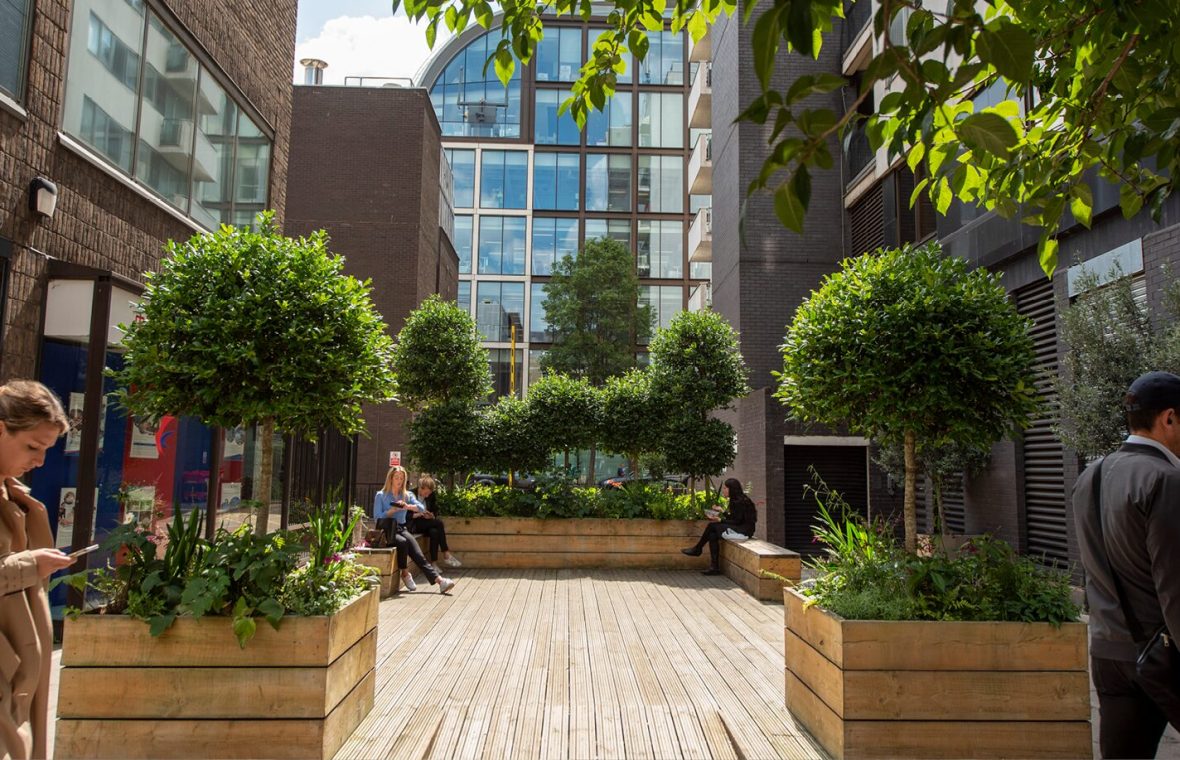
Baker Street Quarter Partnership has installed 50 planters across the area through a range of partnerships and funding streams, helping to green our streets and improve the local environment.
✦ Baker Street, Glentworth Street, Marylebone Road & Melcombe Street – delivered in partnership with Berkeley Court.
✦ Melcombe Street & Melcombe Place – funded through Westminster City Council’s Greening Westminster Fund.
✦ Marylebone Station (entrance and Platforms 3a & 4b) – delivered with Chiltern Railways through their Community Investment Fund.
Each planter has been carefully designed according to sunlight, location and footfall to help the plants thrive.
Below you will find the names and descriptions of some of the plants used, all of which have been carefully chosen to increase biodiversity.
-
Sedge 'Ice Dance' (Carex morrowii)
An evergreen sedge forming a low, slow-spreading tufted mound. The green, glossy leaves are edged with white and small, inconspicuous brown flower spikes appear in late spring.
-
Heuchera
A herbaceous perennial forming a neat clump to 30cm in height, with greyish-marbled, dull red leaves, purple beneath, and small pale green flowers from early summer.
-
Japanese Holly Fern
An evergreen fern, deciduous in cold areas, forming a tuft of leathery, pinnate fronds to 70cm long, composed of dark glossy green, broadly sickleshaped leaflets.
-
Spetchley
A prostrate evergreen shrub with very small leaves deeply divided into three narrow lobes; no flowers.
-
Silver ragwort 'Silver Dust'
A subshrub, usually grown as an annual, for its ovate, pinnately lobed, strikingly silvery-white leaves, sometimes with loose clusters of yellow daisy flowers in summer.
-
Big Blue Lilyturf
An evergreen, tuberous perennial forming a dense clump of narrow, arching, leathery, dark green leaves. Dense, upright spikes of small, violet purple flowers appear in autumn, followed by black berries.
-
Rosemary
A group of compact, evergreen shrubs with a prostrate habit linear, dark green highly aromatic foliage. Clusters of blue flowers appear in the spring and summer and occasionally in autumn.
-
Butcher's Broom
A bushy sub-shrub to 75cm, with glossy lance-shaped cladophylls 2.5cm in length, flowering in spring, with glossy red berries on female plants in summer and autumn.
-
Shining-white Ragwort 'Angel Wings'
A clump-forming, evergreen perennial to about 40cm with large, rounded, velvety, silver leaves. Flat, terminal clusters of small, yellow flowers are produced in summer.
-
Lamb's Ear 'Big Ears'
A mat-forming herbaceous perennial with soft, grey-green, slightly hairy foliage which is larger than other varieties. Upright stems of small pink to purple flowers appear from June through to September. An excellent choice as ground cover to suppress weeds and drought-tolerant and a tactile choice for a sensory garden.
-
Hardy Geranium
A hardy, clump-forming perennial with attractive, saucer-shaped flowers. Flowers are produced over a long period through spring and summer and are attractive to pollinating insects.
-
Viburnum
Deciduous and evergreen shrubs, grown for their attractive foliage and clusters of small white and pink-flushed flowers.
-
Stipa Grass
An ornamental grass forming graceful clumps of fine, narrow foliage. Soft, feathery flower heads emerge above the leaves in summer.
-
Griselinia
A dense, evergreen shrub with glossy, oval, bright green leaves. Its fresh foliage provides year-round colour and structure, with small, inconspicuous yellow-green flowers appearing in spring.
-
Muehlenbeckia
A compact, spreading evergreen with slender, wiry stems and small, rounded dark green leaves. Tiny greenish-white flowers may appear in summer.
-
Fatsia japonica 'Spider's Web
A bushy evergreen shrub with large, glossy, deeply lobed leaves, heavily speckled and edged with creamy white. Rounded clusters of small white flowers appear in autumn, followed by dark berries.
-
Salvia
Perennials producing colourful spikes of tubular flowers over a long flowering period. The flowers are particularly attractive to bees and other pollinating insects and are often accompanied by fragrant foliage.